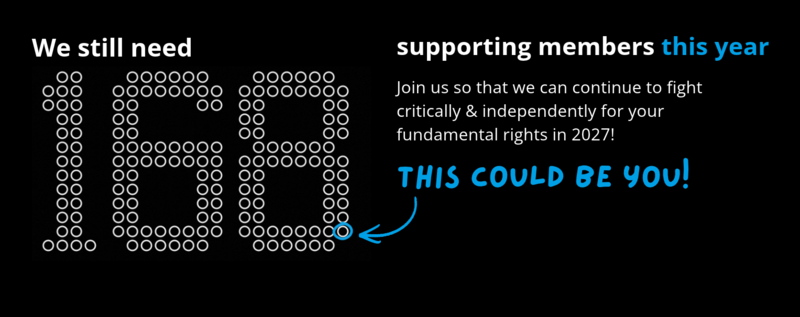
We Still Need 168 People. Be One of Them!
Infrastructure is invisible as long as it works. Nobody thinks about the water pipe until the tap runs dry. Fundamental rights are the same. We only notice them when they are gone.
When the police run your face through a database because you went to a protest. When an algorithm issues a decision about you that no human ever read. When your internet provider decides which websites load fast and which crawl.
For 16 years, we have made sure it does not come to that. Independent, fact-based and carried by people like you. Now that there is more at stake than ever before, we need you at our side.
Don't Take Us For Granted
When a ministry sends a draft law out for public consultation, the deadline is short. Hundreds of pages, paragraphs that point to other paragraphs, and at the end of it all, the whole thing is supposed to be good for the people. Corporations have legal departments and lobbying budgets for moments like this. We have a small team that reads every line, does the maths, checks the details and then says out loud when our fundamental rights are in danger.
Last year's results speak for themselves. As our Transparency Report 2025 shows, we
- analysed 13 legislative proposals and submitted statements on them,
- published 7 policy papers and wrote 12 open letters to authorities,
- held 442 meetings with politicians and stakeholders, 285 of them at international level,
- made 259 public appearances, including 187 workshops with our epicenter.academy,
- and explained what is at stake on TV 69 times, 6 of them on the major news programmes.
None of this happens by itself. It happens because 2,127 supporting members make sure, month after month, that we can fight for their fundamental rights. That is 2,127 good reasons to keep going. But the fronts keep multiplying, and the fights are getting bigger. To take them all on, we need more people at our side.
What Is Still on the Table at Year's End
While we are crunching the numbers here, the next drafts are already landing on our desk. At the end of the year there are more open fronts than ever, and each one helps decide how freely we can move in digital space.
The Open Internet Is Up for Negotiation Again
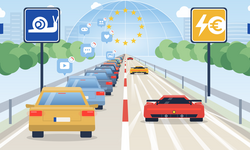
For almost ten years, net neutrality in the EU has guaranteed that all data is treated equally, whether it comes from a start-up, a small association or a billion-euro corporation. This very foundation is now up for grabs.
With the Digital Networks Act, presented on 21 January 2026, the European Commission put forward the biggest reform of net neutrality in a decade. It is sold as technical modernisation. In truth, it is the telecom giants' wish list, with paid fast lanes, network fees through the back door and weakened independent regulators.
We analysed the proposal on the very day it was published, we are supplying MEPs in the European Parliament with amendments and we are building a Europe-wide campaign again with savetheinternet.eu. Because infrastructure is invisible, it is happily negotiated in back rooms. This law will keep us busy for years. Whoever is not at the table now will have no say later.
Government Surveillance. Two Cases That Could Change Everything
Austria’s government spyware before the Constitutional Court. In 2019, the Austrian Constitutional Court (VfGH) struck down Austria’s law for government spyware as unconstitutional. Still, in July 2025 the government passed the surveillance of end-to-end encrypted messengers, on its fifth attempt. The problem remains the same. To get spyware onto a phone unnoticed, the state has to keep security flaws open. That leaves millions of devices unsafe, including yours. We supported the constitutional complaint against the law, and in June the Court held a public hearing. The ruling is expected this year.
Facial recognition against a climate activist. In March 2023, N. was arrested at a protest against the gas conference in Vienna. Only when he asked did he learn that the police had automatically matched his photo against their database. We filed a complaint on his behalf, and this summer the Data Protection Authority ruled in our favour. The use was unlawful. That means all previous matches of this kind lacked a legal basis too. The Interior Ministry refuses to accept this, and the case is now in court.
Why does this matter so much to us? Whoever knows they will be identified at a protest may stay at home next time. In Hungary, we see how facial recognition is used deliberately to restrict protest. This must not happen in Austria.
AI Must Not Erase Human Responsibility
AI creeps more and more into our daily lives. It decides who gets funding, who counts as a suspect, which decision lands in your mailbox. We have been warning about this for years. The Austrian public employment service (AMS) used an algorithm that sorted jobseekers into three categories and factored in care duties only for women. We stood up against it and opened the black box.
With this year's amendment to the General Administrative Procedure Act (AVG), our worst fears have come true. Authorities may now issue decisions fully automated, even with AI and without a human in the loop. At the same time, language models hallucinate, as Austria’s AI assistant "ida" showed in impressive fashion. We submitted an opinion, wrote an open letter to the parliamentary Constitutional Committee and raised the alarm across Europe.
We are staying on it, from the regulations that decide where machines may make the call to the government's new AI strategy. Our demands are clear. Austria finally needs an independent AI oversight authority, as the AI Act provides for. And facial recognition in public spaces has to be banned.
Big Tech Against Democracy
A handful of tech oligarchs determine what billions of people see, read and believe. They openly court authoritarian politics, ignore European law and turn our private lives into their business model. We have held our ground for 16 years.
This year we showed that it pays off. Meta wants to bring glasses with a camera, microphone and AI into our everyday lives that hardly anyone can tell apart from normal glasses. Together with #aufstehn, we launched the petition "Stop Smartglasses!" Over 30,000 people signed. At the end of October, the government announced rules. No smart glasses in schools, changing rooms and courts, and a recording light that cannot be switched off.
Meanwhile, the debate is taking a dangerous turn. Instead of regulating the corporations, lawmakers want to monitor the users. A social media ban for minors means, in practice, that everyone has to prove who they are online. There is a better way. We are showing how to protect children without abolishing the anonymous internet.
And this is only part of our work. We also fight for
- router freedom, so that you decide which device sits in your home,
- transparency in digital identity, because with whoidentifies.me we make visible who requests which of your data through the EU wallet,
- an informed public, with our net policy evenings, workshops against digital violence and analyses that anyone can use freely.
Why You, and Why Now
We take no money that makes us dependent. No single company may contribute more than 7.5 percent of our budget, and the entire private sector at most 30 percent. The foundation of our work is many small contributions from civil society. Only that allows us to take on ministries, corporations and intelligence services without having to look over our shoulder at funders.
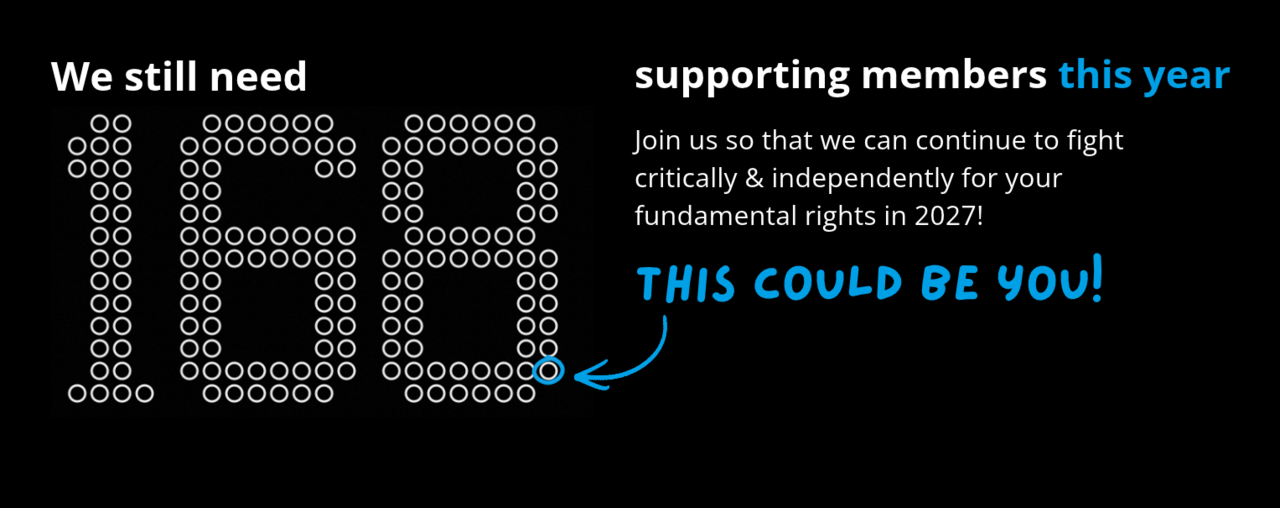
Supporting memberships are the heart of it. Regular contributions give us planning security. They decide whether we can see a case through that takes years. Whether we are in Brussels when the open internet is put to the vote. Whether we can write an opinion when yet another draft law turns up with a short consultation period. By 31 December, we are still 168 supporting members short.
Double the Impact. Donate and Deduct by 31 December
Donations and membership fees to epicenter.works are tax deductible in Austria. Depending on your income, you get up to 40 percent back from the tax office. A supporting membership at 15 euros a month therefore effectively costs you only 9 euros.
To have your donation taken into account automatically, simply enter your first and last name (as in the residents' register) and your date of birth. With your consent, we send the data to the tax office, and you do not have to do anything else. Everything that reaches us by 31 December still counts for your 2026 tax.
Become One of Us!
In the coming months, decisions will be made on government spyware, on facial recognition by the police and on the future of the open internet. Whether we are there with full strength is decided now. With you.
- 168 people are still missing by New Year's Eve. Be one of them and help us stay on all fronts in 2027. Become a supporting member now.
- Cannot contribute regularly right now? A one-off donation helps too and is just as deductible. Donate once.
- And if you share this text with your friends, you help us find the 168.
Since you're here
… we have a small favour to ask. For articles like this, we analyse legal texts, assess official documents and read T&Cs (really!). We make sure that as many people as possible concern themselves with complicated legal and technical content and understand the enormous effects it has on their lives. We do this with the firm conviction that together we are stronger than all lobbyists, powerful decision makers and corporations. For all of this we need your support. Help us be a strong voice for civil society!
Become a supporter now!