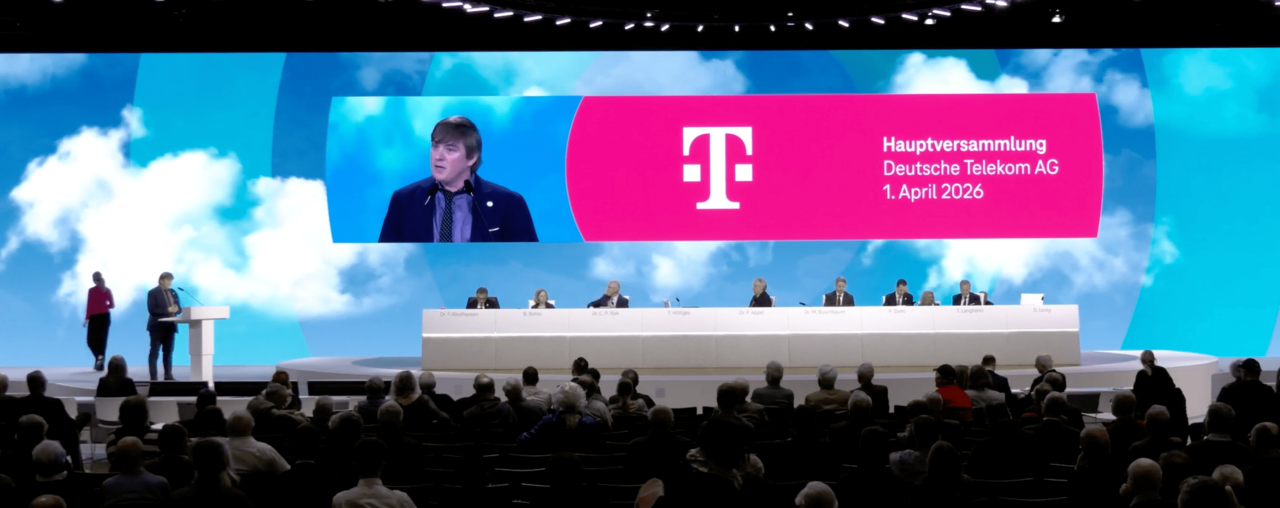
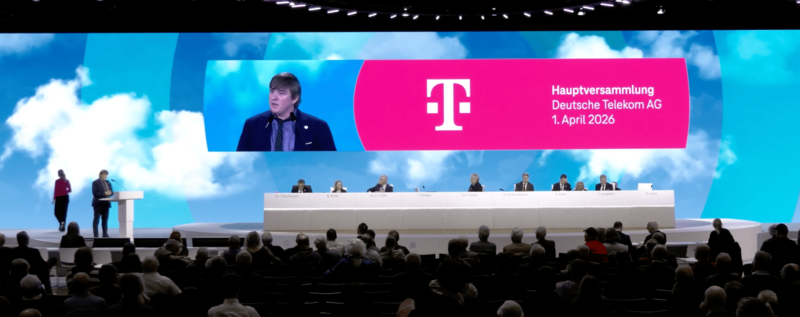
Telekom Annual General Meeting 2026: Broken Internet – and Who Pays for It
This was our third time speaking at a Telekom AGM. In 2017 and 2019, we raised the issue of StreamOn – a product we argued was a clear violation of net neutrality and EU law. In 2021, the European Court of Justice proved us right. The product was banned, and data volumes in Germany rose sharply afterwards – at no extra cost to customers.
The pattern is always the same: Telekom artificially degrades its offers and service quality, then sells exceptions to the scarcity it created. Ban the artificial shortage, and things improve for everyone. We are now seeing exactly this pattern play out in interconnection.
How the Internet Actually Works
The “inter-net” — the network of networks — exists through interconnection. The global industry standard: networks connect with each other on equal terms, without exchanging money. Data flows freely, and everyone earns from their own customers. This is called settlement-free peering—and it is the most cost-effective solution for all parties involved, as regulatory authorities have confirmed.
According to figures from Packet Clearing House from 2021, 99.9996% of all peering agreements worldwide are free of charge. Telekom belongs to the 0.0004% that demand payment for interconnection, making it almost the only outlier in Germany. Those who refuse to pay find themselves poorly reachable within Telekom's network. Telekom can get away with this because of its market power and only within Germany.
Billing Twice for the Same Service
When ARD, ARTE, or Spotify send data packets to Telekom, they do so because Telekom's own customers want to use those services. Delivering that connection is precisely the "internet access service" Telekom has already sold to its customers. In other words, Telekom wants to charge twice: once from its customers, and once from the services those customers want to reach.
We are not talking about trivial sums. According to Tagesschau, we are talking about high four-digit to low five-digit amounts per month for a medium-sized German company. We are talking about German research networks that were unreachable for students during the pandemic lockdowns because Telekom demanded more money for interconnection. We are talking about a small regional internet provider whose customers suddenly couldn't access online banking because the bank is hosted in Telekom’s network, and the small competitor must now pay the former monopolist for it.
This issue is not about Big Tech vs. Big Telco. Large American providers actually receive discounts from Telekom – paying less than European companies for the same service, simply due to volume. Industry associations such as VATM and CISPE — both of which only have European member — have publicly confirmed this problem with Telekom.
Fear as a Business Model
What struck us most in researching this issue is how afraid the affected companies are. Everyone knows about the problem. Hardly anyone speaks about it publicly. Those who dosoon find themselves facing higher costs, or having their connection to 40% of the German market cut off. For a European company, that can be a death sentence.
We'll say it plainly: these methods are reminiscent of mafia movies. This should be banned. That is exactly what the Federal Network Agency exists to prevent.
We Have Filed a Complaint
Together with the Federation of German Consumer Organisations, the Society for Civil Liberties, and Barbara van Schewick (Stanford Law School), we have filed a complaint with the Federal Network Agency against Telekom’s interconnection practices.
At netzbremse.de you can find the full complaint, informational materials, and a speed test that you can use to demonstrate the problem yourself. And because we as an NGO rely on donations: if an open internet is important to you, every contribution counts.
Since you're here
… we have a small favour to ask. You want to keep a close eye on the government? You want to stay up-to-date on surveillance, privacy, net neutrality, and all matters related to your fundamental rights on the internet? Subscribe to our newsletter and approximately once a month, we will send you a message (in German) about everything that happens around digital policy in Austria and in Europe, about our actions, legal analyses and position papers.
Together, we defend our fundamental rights in the digital age – because civil society works! Stay informed!